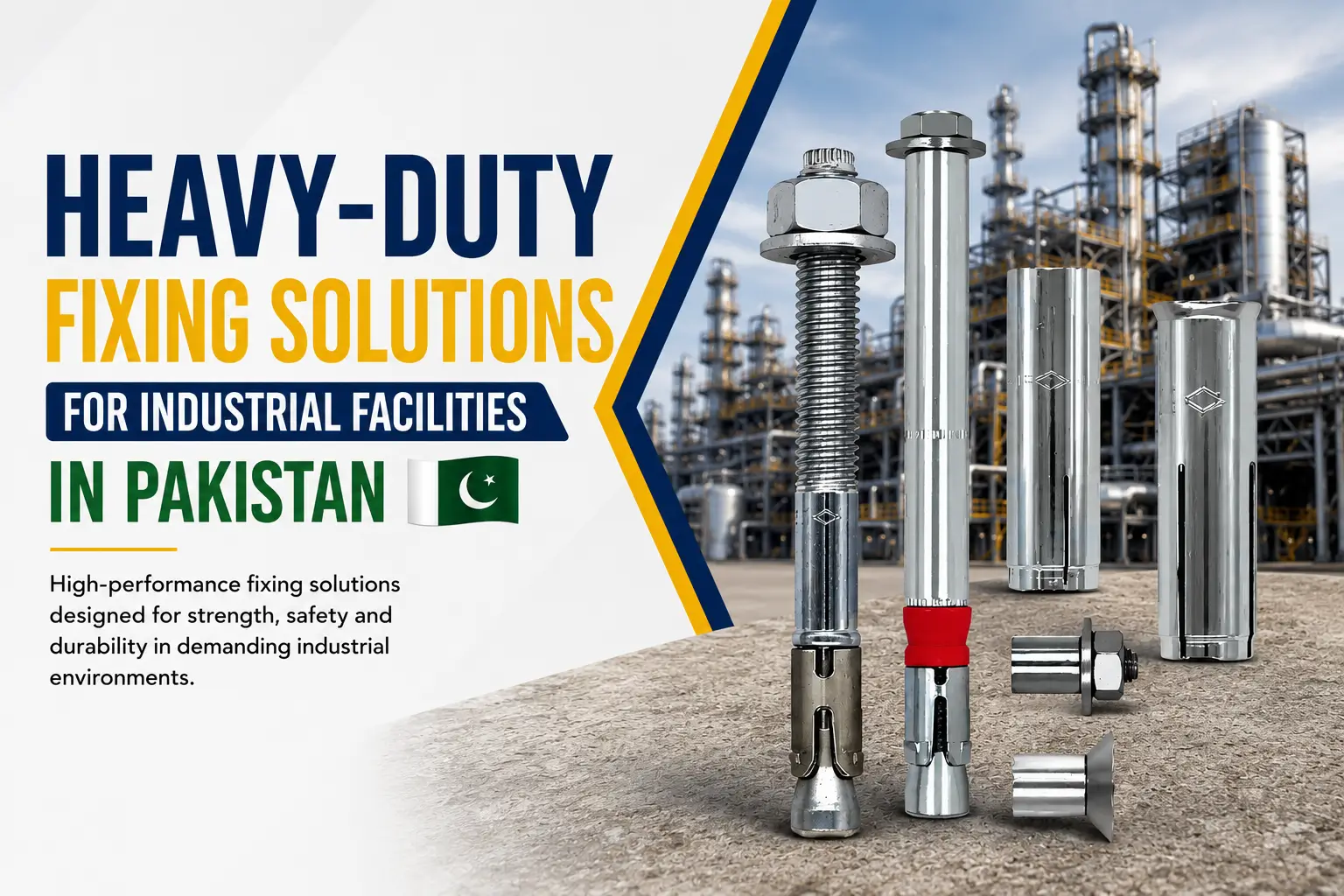
Industrial facilities are the true powerhouses of Pakistan’s growing economy. From the massive textile mills in Faisalabad and the sprawling manufacturing plants in Karachi to the heavy industrial zones in Lahore, these facilities keep the country moving.
Inside these factories, you will find incredibly heavy machinery, giant HVAC units, massive piping systems, and complex electrical cable trays.
But have you ever wondered what keeps all this heavy equipment safely anchored to the ground or suspended from the ceilings?
The answer is high-performance, heavy-duty fixing solutions. If an anchor bolt fails in a residential home, it is a nuisance. If a heavy-duty anchor fails in an industrial plant, it can cause catastrophic machinery damage, halt production lines, and put worker safety at serious risk.
That is why modern industrial projects are moving away from cheap, uncertified local fixing methods. Instead, they are turning to international engineering standards.
In this comprehensive guide, we will explore the world of industrial anchoring and look at why the MKT Anchoring and Fastening Solutions, proudly offered by Ingenious Fixing Solutions, has become the preferred choice for heavy-duty applications across Pakistan.
The Industrial Environment: Why Basic Fixings Just Won’t Cut It
Industrial facilities are completely different from commercial or residential buildings. They subject structural fixings to extreme stresses every single day. Before we look at the solutions, let’s look at the unique challenges faced by industrial plants in Pakistan:
1. Dynamic Loads and Continuous Vibration
In a textile mill or a cement factory, massive machines run 24/7. These machines create constant, heavy vibrations. This is known as a dynamic load. Over time, these vibrations can cause standard, low-quality anchor bolts to slowly loosen and slip out of the concrete, leading to sudden machinery misalignment or failure.
2. High Thermal Stress
Industrial processes often involve a lot of heat. Boilers, furnaces, and steam pipes cause the surrounding concrete and steel supports to expand and contract. Your heavy-duty fixings must be able to handle these temperature swings without losing their grip.
3. Aggressive Chemical Exposure
Many manufacturing units, especially chemical processing plants and pharmaceutical facilities, use aggressive cleaning agents or deal with chemical fumes. Standard steel anchors will rust and corrode rapidly in these environments. Once rust sets in, the anchor loses its structural integrity.
4. Severe Weather and Humidity
Pakistan has a diverse and challenging climate. Industrial zones in coastal areas like Karachi deal with intense salt-air humidity, which accelerates metal corrosion. Meanwhile, facilities in northern areas must be engineered to withstand seismic activity and earthquakes.
Mechanical vs. Chemical Anchors: Understanding Your Options
When it comes to heavy-duty anchoring, the MKT fastening range from Ingenious Fixing Solutions generally falls into two major categories: Mechanical Anchors and Chemical Injection Systems. Both have their own unique superpowers. Let’s break them down in simple terms.
Mechanical Anchors: Brute Force and Instant Strength
Mechanical anchors work by expanding inside a pre-drilled hole in the concrete. As you tighten the bolt, the expansion sleeve presses incredibly hard against the walls of the hole, creating a friction lock.
- The Biggest Benefit: They provide instant load-bearing capacity. The moment you torque the bolt to the correct specification, you can hang your heavy pipes or mount your machines. There is zero waiting time.
- Best Used For: Structural steel columns, heavy-duty pipe supports, and crane runways.
Chemical Anchors: Stress-Free, Infinite Bonds
Chemical anchoring involves drilling a hole, injecting a high-strength chemical resin, and then inserting a threaded steel rod or rebar. The resin cures and glues the metal rod directly to the concrete.
- The Biggest Benefit: Chemical anchors do not create expansion stress inside the concrete. When you tighten a mechanical anchor, it pushes outward. If you place multiple mechanical anchors too close together, or too close to the edge of a concrete slab, the concrete can crack. Chemical anchors don’t do this, making them perfect for close spacing and edge installations.
- Best Used For: Heavy machinery foundations, rebar extensions, and anchoring in older or weaker concrete.
Learn more about their comparison in the recent article of Chemical Anchors vs Mechanical Anchors.
Deep Dive: Superstar Products in the MKT Anchoring Range
Let’s take a closer look at the specific MKT solutions that engineering consultants and contractors specify for Pakistani industrial projects.
1. MKT SZ Highload Anchors (The Heavyweight Champion)
When a project demands the absolute highest level of mechanical safety, the MKT SZ Highload anchor is called into action. This is a heavy-duty sleeve anchor featuring a unique three-part expansion sleeve.
- Why It’s Preferred: It is specifically certified for both cracked and uncracked concrete. It can handle extreme shear loads (forces pushing sideways) and tension loads (forces pulling straight out).
- Industrial Application: Ideal for securing heavy manufacturing machinery, robotic arms, and structural steel framing that experiences heavy dynamic movement.
2. MKT BZ Plus Wedge Anchors (The Reliable Workhorse)
For everyday heavy-duty applications, the MKT BZ Plus wedge anchor is the industry go-to. It combines high performance with rapid installation.
- Why It’s Preferred: It features a special zinc-plated or hot-dip galvanized coating that offers excellent protection against rust. It is also approved for seismic zones, making it an excellent choice for industrial facilities in earthquake-prone regions of Pakistan.
- Industrial Application: Perfect for securing conveyor belts, storage racks, and overhead crane rails.
3. MKT VMU Plus Chemical Injection System (The All-Rounder Resin)
The MKT VMU Plus system is a styrene-free, high-performance vinyl ester injection adhesive. It is a true multi-purpose chemical anchor.
- Why It’s Preferred: It is certified for use in cracked concrete, uncracked concrete, and even solid brickwork or hollow blocks. Because it is styrene-free, it doesn’t emit harsh chemical smells, making it safe for indoor installations in food processing or pharmaceutical plants. It can even be used in water-filled drill holes!
- Industrial Application: Used for anchoring heavy process piping, rebar connections for factory expansions, and structural retrofitting.
4. MKT V-P Glass Chemical Capsules (Error-Free Anchoring)
If you want to eliminate human error on the construction site, the MKT V-P Glass Capsule system is a fantastic choice. Instead of using a manual caulking gun to mix and inject resin, you simply drop a pre-measured glass capsule filled with vinyl ester resin into the drilled hole.
When you drive the threaded stud into the hole using a rotary hammer drill, the glass capsule shatters, perfectly mixing the resin and activator inside the hole.
- Why It’s Preferred: There is zero product waste and zero guesswork. Every single hole gets the exact right amount of chemical bonding agent.
- Industrial Application: Excellent for high-volume anchoring jobs like installing long rows of heavy warehouse racking or massive cable tray systems.
Why International Compliance (ETA Approvals) Matters for Pakistan
In the past, many industrial projects in Pakistan relied on uncertified local anchors bought from local hardware markets. These are often referred to as “Jugaad” solutions. While they might look strong on the outside, they have no engineering data backing them up.
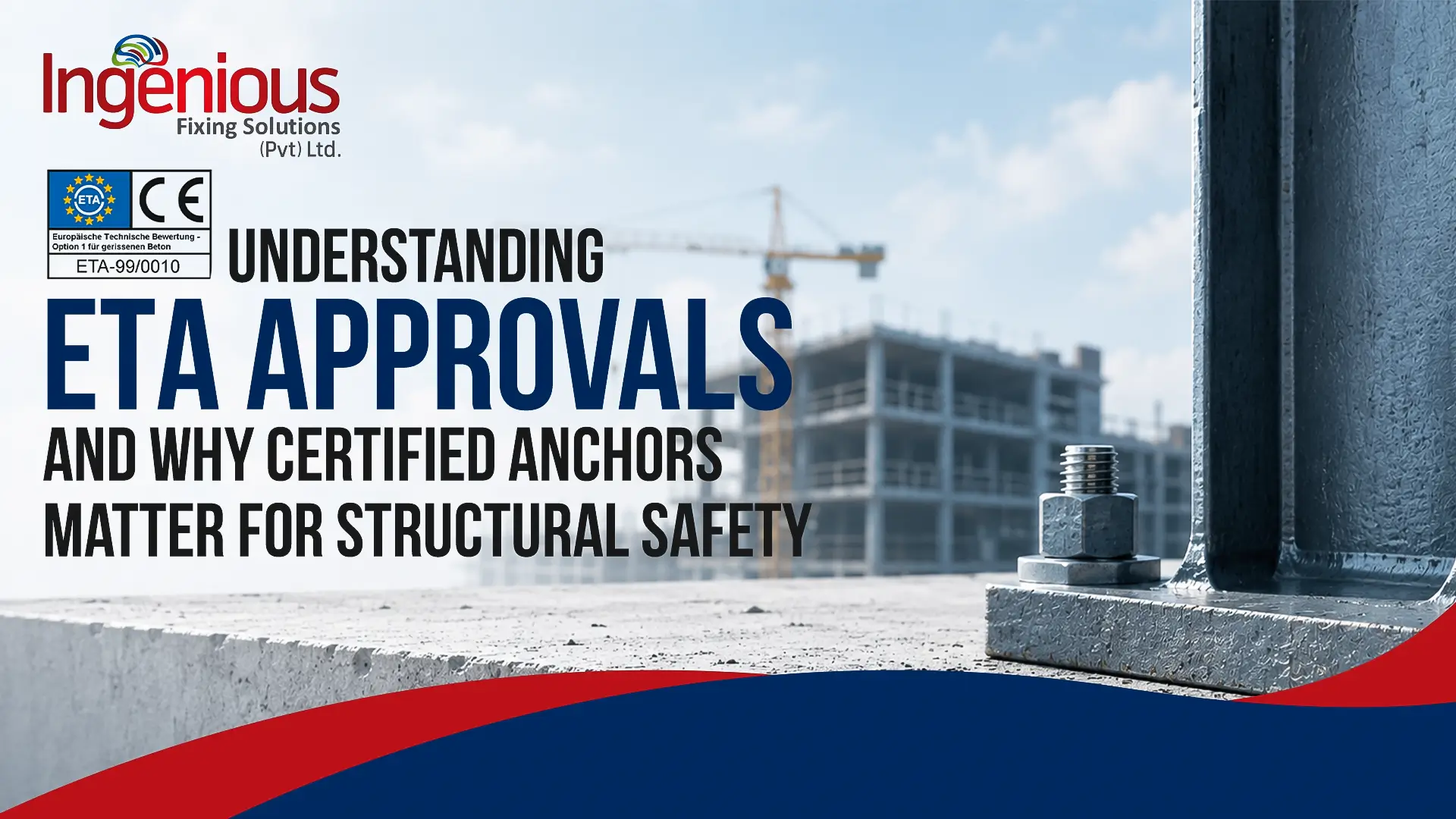
Modern industrial projects cannot afford to take these shortcuts. That is why the MKT range is highly preferred. MKT products carry official European Technical Assessments (ETA). If you want to understand exactly why this certification matters and why so many anchor submittals get rejected without it, read our full guide on why ETA-approved anchors matter for structural safety.
What does an ETA approval mean for your factory?
- Guaranteed Load Ratings: If the MKT data sheet states that an anchor can hold 5,000 kg, it has been rigorously tested in German laboratories to prove it. Engineers can perform precise mathematical calculations without guessing.
- Long-Term Safety: ETA testing simulates a 50-year lifespan under extreme stress. You can rest easy knowing your factory structures are secure for decades.
- Audit Compliance: International buyers and multinational corporations auditing Pakistani factories look closely at structural safety. Using ETA-certified MKT fixings helps your facility meet global compliance standards easily.
The Advantages of Partnering with Ingenious Fixing Solutions
Choosing the right bolt anchors are only half the battle. You also need to know how to design the layout and install them correctly. That is where Ingenious Fixing Solutions comes in. As your local engineering partner, they provide complete end-to-end support for industrial projects.
1. Advanced Engineering Software Support
You don’t have to guess which anchor size you need. The technical team at Ingenious Fixing Solutions uses advanced design software to calculate the exact anchor size, embedment depth, and spacing required for your specific industrial loads.
2. On-Site Pull-Out Testing
Are you worried about the quality of the concrete in an old factory building? Ingenious Fixing Solutions can perform professional on-site pull-out tests. They use specialized hydraulic equipment to apply force to an installed MKT anchor until it reaches its design load. This gives you empirical proof that the concrete can safely hold your new machinery.
3. Contractor Training and Quality Control
Even the best German-engineered anchor will fail if it is installed incorrectly. If a worker fails to blow the dust out of a drilled hole before injecting chemical resin, the bond strength can drop by over 50%. Ingenious Fixing Solutions provides hands-on on-site training for your installation crews, ensuring every MKT anchor is installed perfectly according to international guidelines.
Summary: The Key Benefits of the MKT Range
If you are a project manager, procurement officer, or plant engineer, here is a quick summary of why MKT heavy-duty anchors are the smart choice for your facility:
- German Engineering: Manufactured to strict international quality standards.
- Vibration Resistant: Highload anchors stay tight even under constant machinery hum.
- Seismic Approved: Engineered to keep structures safe during earthquakes.
- No Expansion Stress Options: Chemical resins allow for close anchor spacing near concrete edges.
- Complete Local Support: Technical guidance, design software, and on-site testing provided by Ingenious Fixing Solutions.
Conclusion: Securing the Foundations of Tomorrow’s Industry
As Pakistan’s industrial landscape becomes more advanced, the demand for safety, efficiency, and international compliance is higher than ever. Investing in cheap, uncertified anchoring solutions is a risk that can result in costly downtime, ruined machinery, or tragic accidents.
By choosing MKT Heavy-Duty Fixing Solutions through Ingenious Fixing Solutions, you are choosing absolute peace of mind. You are ensuring that your machinery stays stable, your piping systems remain secure, and your workforce stays safe.
Don’t leave the safety of your industrial facility to chance. Build it right, anchor it smart, and secure your facility’s future.
Are you planning a new factory setup or upgrading your current industrial machinery? Get in touch with the engineering team at Ingenious Fixing Solutions today for your project!
Frequently Asked Questions (FAQs)
1. What is the difference between an ETA-approved anchor and a standard local anchor?
An ETA (European Technical Assessment) approval means the anchor has undergone strict independent laboratory testing for weight capacity, lifespan, and safety under extreme conditions. Standard local anchors (“Jugaad” fixes) have no certified data, meaning you are guessing their strength, which puts heavy industrial machinery and worker safety at risk.
2. Can MKT mechanical anchors be used in earthquake-prone regions of Pakistan?
Yes. Key products in the MKT mechanical range, such as the MKT BZ Plus wedge anchor and the SZ Heavy-duty anchor, are explicitly certified for seismic performance categories. This makes them ideal for industrial facilities located in seismically active zones across Pakistan.
3. How long does it take for MKT chemical anchors to cure before they can hold a load?
Curing time depends entirely on the concrete temperature during installation. For instance, the MKT VMU Plus resin cures much faster in hot summer temperatures (common in regions like Sindh and Punjab) than in cold winter temperatures. The installation guide on the cartridge provides a precise temperature-to-time chart. Mechanical anchors, on the other hand, can bear loads instantly upon torqueing.
4. Why should I use chemical anchors near the edge of a concrete slab?
Mechanical anchors expand outward, creating high stress inside the concrete. If they are placed too close to an edge, they can split the concrete block. MKT Chemical anchors (like the VMU Plus or V-P Capsules) bond the steel rod to the hole using chemical adhesion without outward expansion force, making them perfectly safe for edge installations.
5. What support does Ingenious Fixing Solutions offer during a project?
Ingenious Fixing Solutions provides complete engineering support. This includes calculating anchor specifications using advanced design software, offering on-site pull-out testing to verify local concrete strength, and conducting hands-on training for your site contractors to ensure error-free installation.