When you are standing in the middle of a busy construction site, or even just planning a major facility upgrade, you are surrounded by heavy things. Huge HVAC units, massive piping networks, structural steel beams, and giant industrial machines all have one thing in common: they need to be pinned down to the concrete.
If they aren’t held down tightly, things can go wrong very quickly.
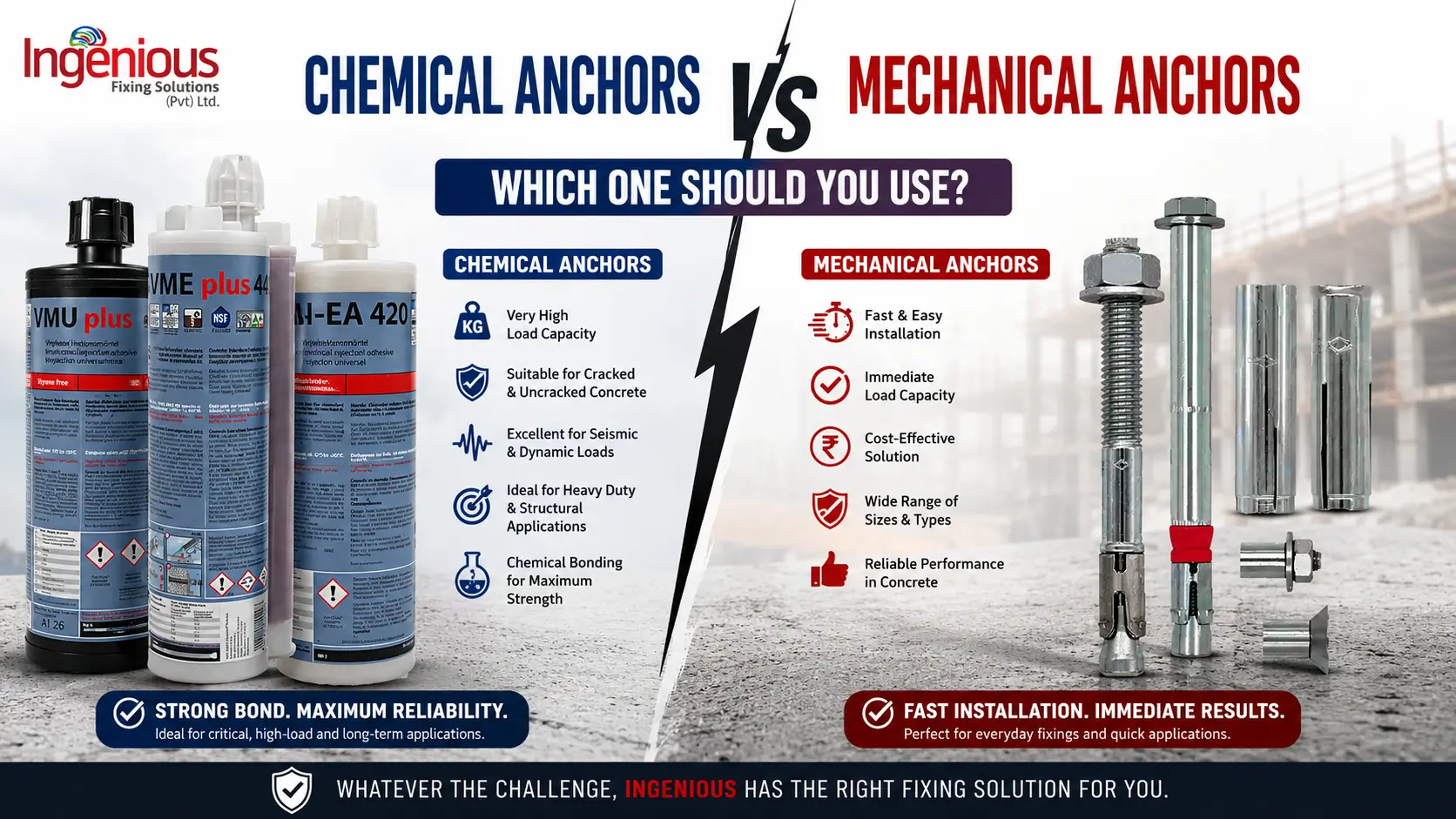
To hold these heavy loads, engineers and contractors rely on heavy-duty anchors. But as you start looking at your options, you will quickly find yourself standing at a crossroads. On one side, you have Mechanical Anchors. On the other side, you have Chemical Anchors.
Both of these systems are designed to do the same basic job i.e. hold heavy stuff to concrete, but they do it in completely different ways.
Choosing the wrong one can lead to cracked concrete, failed installations, or wasted project budgets. In this friendly guide, we will break down the battle of Chemical Anchors vs. Mechanical Anchors so you can confidently choose the perfect option for your next project.
The Basics: What is a Mechanical Anchor?
Let’s start with the traditional favorite: the mechanical anchor. If you have ever used a plastic wall plug to hang a heavy mirror at home, you already understand the basic concept of a mechanical anchor. It is all about physical force and friction.
Mechanical anchors are made completely of metal components. When you place a mechanical anchor into a pre-drilled hole in the concrete and tighten it, a specific part of the anchor expands outward.
How It Works: The Friction Lock
Think of a standard wedge anchor or a sleeve anchor. As you turn the nut with a wrench, a metal cone is pulled up into a expandable metal sleeve. This forces the sleeve to widen and press incredibly hard against the inside walls of the concrete hole. This creates a massive “friction lock.”
The anchor stays in place because the metal sleeve is pushing outward so hard that the friction prevents it from being pulled out.
Popular Types of Mechanical Anchors
- Wedge Anchors: Excellent for heavy-duty structural steel connections.
- Sleeve Anchors: Great for brick, block, and concrete base materials.
- Heavy-Duty Shield Anchors: Built for high-load environments where shear strength is critical.
- Concrete Screws: A modern favorite that cuts its own threads directly into the concrete hole for easy removal.
The Basics: What is a Chemical Anchor?
Now let’s switch gears and look at the chemical anchor. If mechanical anchors rely on physical force, chemical anchors rely on the power of chemistry. They don’t grip the concrete by pushing against it; they literally glue themselves to it.
A chemical anchoring system involves a steel threaded rod (or a piece of rebar) and a high-strength chemical resin adhesive.
How It Works: The Chemical Bond
First, you drill a hole into the concrete. Next, you fill that hole with a specialized chemical resin—usually using an injection cartridge with a manual caulking gun or a ready-made glass capsule. Finally, you push and twist your steel rod into the wet chemical mixture.
As the resin cures, it undergoes a chemical reaction and hardens into a solid, rock-like plastic. This resin completely fills every tiny microscopic pore and imperfection inside the drilled hole. Instead of a friction lock at a single point, a chemical anchor creates an unbreakable bond along the entire length of the embedded steel rod.
Popular Types of Chemical Resins
- Vinyl Ester Resins: High-performance, fast-curing resins that can handle wet conditions and heavy structural loads.
- Epoxy Resins: The ultimate heavy-lifters. They take longer to cure but provide the absolute highest load capacities and are perfect for deep embedment.
- Polyester Resins: Great for medium-duty, everyday anchoring tasks where budget is a high priority.
Head-to-Head: The Major Differences You Need to Know
To decide which system is best for your specific project, let’s compare them across the most critical categories on a job site.
1. Speed of Installation and Load Time
- Mechanical Winner: If you are in a rush, mechanical anchors are the clear champion. The moment you drive a mechanical wedge anchor into the concrete and torque it down to specification, it is ready to bear 100% of its design load. There is zero waiting time. You can bolt your steel bracket down and keep moving.
- Chemical Challenge: Chemical anchors require patience. Once you inject the resin and insert the rod, you must wait for the chemical to fully cure before you can apply any weight. Depending on the type of resin and the ambient temperature, this can take anywhere from 20 minutes to several hours. If you hang a heavy pipe too early, the anchor will slide right out.
2. Edge Distance and Anchor Spacing
- Chemical Winner: This is where chemical anchors truly shine. Because mechanical anchors rely on expanding outward, they put a lot of constant stress on the surrounding concrete. If you place a heavy mechanical anchor too close to the edge of a concrete slab, that outward pressure can cause the concrete corner to crack and break off completely. Chemical anchors do not create any expansion stress. You can place them very close to edges and tight against each other without risking a blowout.
- Mechanical Challenge: Because of expansion forces, mechanical anchors require strict minimum edge distances and wide spacing between multiple bolts to prevent structural cracking.
3. Substrate Material and Concrete Quality
- Mechanical Challenge: Mechanical anchors are very picky about their environment. They work best in solid, high-quality, uncracked concrete. If the concrete is old, soft, honeycombed, or made of hollow blocks, a mechanical anchor will struggles to find a secure grip. It might just crack the brittle material or spin endlessly in the hole.
- Chemical Winner: Chemical resins are highly adaptable. Because the liquid resin flows into every available crack and void, it can anchor safely into hollow blocks, brickwork, and old masonry. It fills the gaps and reinforces the weak base material from the inside out.
4. Flexiblity and Room for Error
- Chemical Winner: Have you ever drilled a hole and realized it was a little too wide, slightly crooked, or a bit too deep? With a mechanical anchor, a bad hole means the anchor is useless. With a chemical anchor, the liquid resin easily fills up any oversized or irregular hole. It accommodates slightly mismatched drilling and still achieves a perfect, certified bond.
- Mechanical Challenge: Precision is mandatory. The drill bit size must match the anchor size exactly, and the hole must be perfectly straight for the expansion sleeve to work correctly.
The Impact of Temperature and Environment
Environmental conditions can completely change how these anchors perform. Let’s look at how they handle real-world challenges.
Extreme Heat and Fire
Mechanical anchors are made entirely of steel, meaning they hold up incredibly well under high temperatures and fire conditions. Chemical resins, being a form of advanced plastic, can lose their structural strength if they are exposed to extreme heat or direct fire for a prolonged period. While modern chemical anchors have fire ratings, mechanical systems generally offer higher baseline resistance to high-thermal stress.
Moisture, Water, and Corrosion
If you are drilling into outdoor concrete during the rainy season, or working on an industrial facility with wet floors, water becomes a major factor.
- Mechanical Risks: If water gets into a mechanical anchor hole, it can cause the metal components to rust over time. Furthermore, if you are anchoring in a coastal town with high humidity and salt air, corrosion can destroy a standard zinc-plated mechanical anchor quickly.
- Chemical Defenses: High-quality vinyl ester and epoxy chemical anchors seal the drilled hole completely. They keep oxygen and moisture out, protecting the embedded steel rod from internal rust. Many top-tier chemical systems are even certified to be installed directly into completely water-filled holes or even underwater!
Summary Table: Quick Comparison
| Feature | Mechanical Anchors | Chemical Anchors |
| Load-Bearing Time | Instant (Immediate loading) | Delayed (Must wait for curing) |
| Edge Distance | Requires wide margins to avoid cracks | Can be placed very close to edges |
| Vibration Resistance | Can loosen over time | Excellent (Absorbs dynamic movement) |
| Hollow Base Materials | Poor (Not recommended) | Excellent (Fills voids and gaps) |
| Installation Precision | Must be perfect and exact | Highly forgiving of irregular holes |
| Fire/Heat Resistance | Naturally very high | Variable (Depends on resin rating) |
When to Choose Mechanical Anchors
To make things simple, you should choose a mechanical anchoring system if:
- You need speed: You want to mount a fixture, tighten the bolt, and finish the job immediately without waiting for glues to dry.
- You have great concrete: You are working with a solid, newly poured, uncracked concrete slab.
- You have plenty of space: Your anchors are placed far away from the edges of the concrete slab or structural columns.
- You are on a tight budget: Standard mechanical anchors are generally more affordable per piece and don’t require special injection tools or mixing nozzles.
When to Choose Chemical Anchors
You should switch to a chemical anchoring system if:
- You are close to an edge: You need to mount a bracket right on the lip of a concrete wall or beam.
- The loads are dynamic: The anchors are holding heavy industrial machinery, pumps, or fans that vibrate constantly. (Chemical bonds absorb vibration much better than friction locks).
- The concrete is unpredictable: You are dealing with older buildings, hollow brickwork, or unknown base materials.
- You want maximum strength: You are setting heavy rebar connections or holding massive structural steel columns where a failure is absolutely not an option.
Conclusion: Build Smarter, Anchor Safer
There is no single “best” anchor in construction. Both mechanical and chemical solutions have earned their place on the modern job site.
Mechanical anchors give you unmatched speed, simplicity, and immediate strength when working under standard conditions. On the flip side, chemical anchors give you incredible structural strength, flexibility, and safety in challenging environments where edge cracking or weak base materials are a major concern.
By evaluating your site conditions, budget, and project timeline, you can master the process of selecting right anchoring system that ensures your heavy installations remain safe, stable, and secure for decades to come. .
Are you preparing the submittals for a major upcoming industrial or MEP project? Don’t leave your structural connections to chance. Get in touch with a professional engineering supplier today to get full load calculations and design support for your anchor layouts!