Most anchor submittals that get rejected in Pakistan fail for one reason. There’s no approval document behind the product. The contractor has already bought the anchors, they look the same as the German ones in the catalogue, and the consultant still won’t sign off. Work stops until someone sorts out the paperwork or pays for pull-out tests.
An ETA is that paperwork. If you specify ETA approved anchors and attach the document to the submittal, this whole problem goes away. The catch is that “ETA approved” gets printed on a lot of boxes that don’t deserve it, so you need to know what the document is, what it covers, and how to check one. This article goes through that using MKT anchors as the example, since Ingenious Fixing Solutions stocks them in Karachi, Islamabad, and Lahore and the approval PDFs are easy to get.
What an ETA actually is
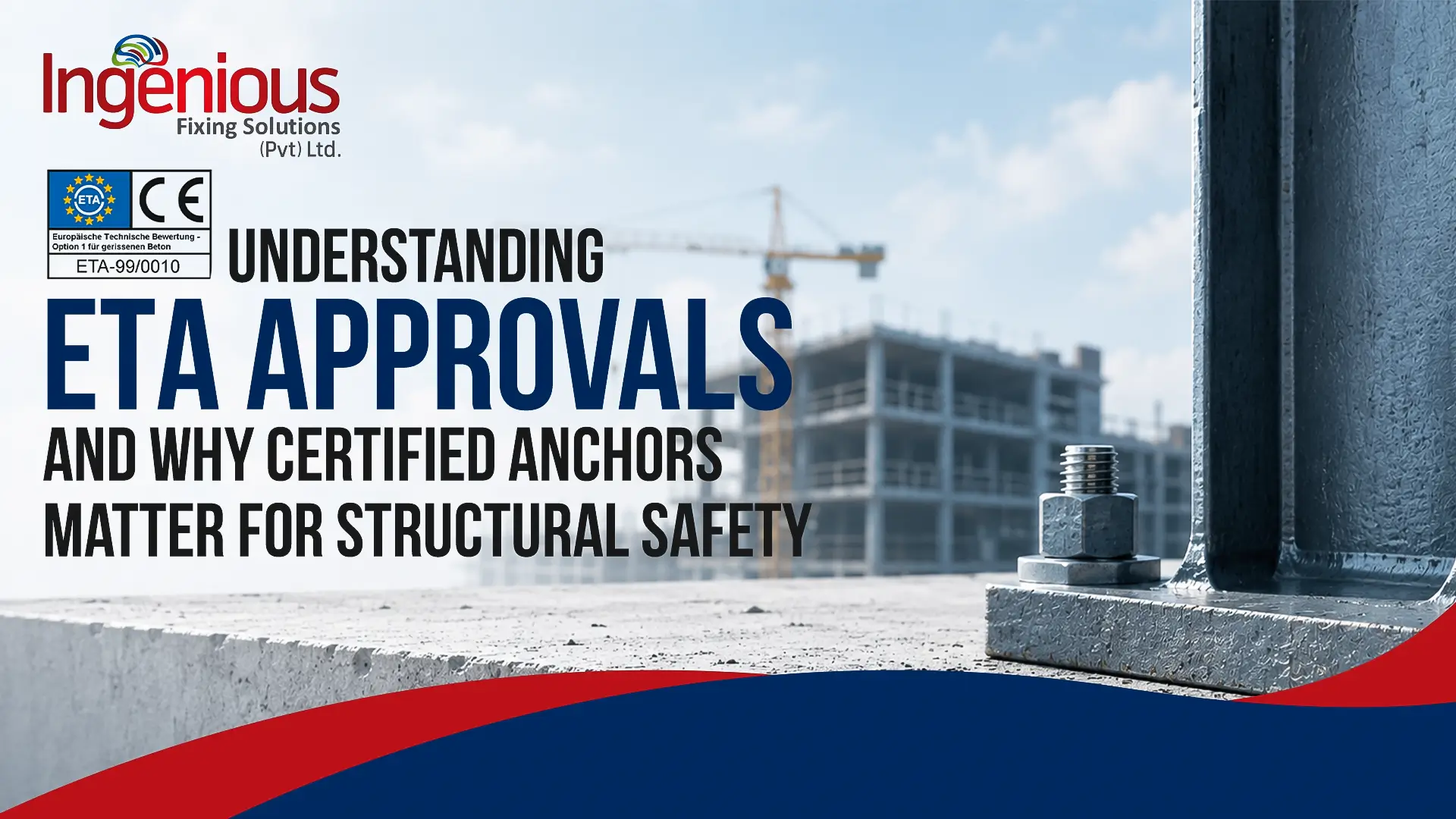
ETA stands for European Technical Assessment. It’s a document issued by a Technical Assessment Body, such as DIBt in Germany, that states how a specific anchor performs under specific conditions. Not “performs well.” Performs at a number. Tension resistance in kN, shear resistance in kN, minimum edge distance in mm, minimum spacing in mm, and the concrete strength those figures apply to.
The assessment is carried out against a European Assessment Document, or EAD. For mechanical anchors in concrete that’s EAD 330232. For bonded (chemical) anchors it’s EAD 330499. For anchors in masonry it’s EAD 330076. Each EAD lays out the test programme the anchor has to pass before anyone writes the numbers down.
Once an anchor has an ETA, the manufacturer can issue a Declaration of Performance and put a CE mark on the box. The CE mark on its own tells you very little. The ETA behind it is the part that matters, because it’s the only place the load values live.
So when someone says an anchor is “ETA approved,” ask for the ETA number. A real one looks like ETA-xx/xxxx and you can download the full PDF from the EOTA or DIBt website in about a minute.
What the testing involves
An anchor doesn’t get an ETA by being strong once in a lab. It gets one by surviving a long list of conditions that mimic what goes wrong on site.
The test programme for a mechanical anchor under EAD 330232 includes installation in concrete that has already cracked, with the crack opening and closing while the anchor carries load. It includes installation with too little torque, in a hole that’s slightly oversized, and with the drill bit at the wrong end of its tolerance. It includes sustained load over time and repeated load cycling. The anchor has to hold through all of it.
Bonded anchors go through a similar list plus a few of their own. Cure behaviour at low and high temperatures. Performance in a damp hole. Performance in a hole that wasn’t cleaned properly. Creep under long-term load, which is the quiet killer for resin systems because a bond that holds for a day can slip over a decade.
This is why the load value in an ETA is usually lower than what you’d get in a perfect lab test. It’s already been reduced to account for the installer who was in a hurry. That’s the point.
The difference between cracked and non-cracked concrete
This is the distinction that catches people out most often in Pakistan, so it’s worth slowing down on.
Concrete cracks. Not because it’s bad concrete, but because it’s concrete. Tension zones in slabs and beams crack under normal service load, and any anchor sitting in that zone has to cope with a crack opening through its hole. An expansion anchor that relies on friction against the hole wall loses grip when the wall moves away from it. Some anchors handle this. Many don’t.
Under the older ETAG 001 system, anchors were assessed under numbered options. Option 1 covered cracked and non-cracked concrete. Option 7 covered non-cracked concrete only. The EAD system carries the same idea forward with different wording, and you’ll still see “Option 1” and “Option 7” in datasheets and in conversation with consultants across Pakistan.
If you can’t prove the concrete around an anchor will stay uncracked for the life of the building, you need a cracked concrete approval. For most structural fixings, that means you need it. The MKT heavy-duty anchor SZ holds an Option 1 approval, which is why it shows up on high-load fixings where the engineer can’t make assumptions about the slab. The bolt anchor BZ3 carries a European Technical Assessment with variable anchorage depths, so you can match embedment to the load rather than over-drilling every hole.
A non-cracked approval isn’t a defect. It’s fine for a lot of secondary fixings in compression zones. The problem is using a non-cracked anchor where a cracked one was needed, and that’s exactly the mistake an approval document stops you making.
Seismic categories C1 and C2
Pakistan’s Building Code Seismic Provisions put Islamabad, Rawalpindi, and Karachi in Zone 2B, much of Khyber Pakhtunkhwa and northern Punjab in Zone 3, and parts of Balochistan and Azad Kashmir in Zone 4. If your project sits in any of those, the consultant will, or should, ask about seismic performance of the anchors.
ETAs cover this with two performance categories. C1 is for anchors that carry load while the structure moves but aren’t expected to see large crack openings. C2 is the harder test, with wider crack cycling and a more demanding load protocol, intended for anchors on structural elements that could be badly damaged in a design earthquake.
An anchor with no seismic category in its ETA hasn’t been tested for it. That doesn’t mean it will fail. It means nobody has checked. On a hospital plant room in Islamabad or a factory in Hattar, “nobody has checked” isn’t a phrase you want on record.
MKT publishes C1 and C2 status for its anchors in the ETA itself. The MKT mechanical anchors stocked by Ingenious includes products approved in both categories, and the Ingenious technical team can tell you which anchor sits in which category for a given diameter before you order.
Why the approval is the product
Here’s a way to think about it. Two wedge anchors, same diameter, same length, same zinc plating, sitting side by side. One has an ETA. One doesn’t. To the eye they’re the same.
They aren’t the same product. The approved one comes with a document that says exactly what it will hold, in what concrete, at what embedment, with what edge distance. That document has the manufacturer’s name on it and a Technical Assessment Body’s stamp. It’s traceable to a factory, a batch, and a test programme.
The unapproved one comes with a number on a website, or on a label, that nobody independent has verified. It might be a good anchor. It might be a copy of a good anchor made with softer steel and a shorter expansion sleeve. You can’t tell by looking, and you can’t tell by a single site pull-out test either, because a pull-out test checks one anchor on one day in one hole.
Pakistani consultants have got stricter about this in the last few years, and for good reason. The shift from “any anchor” to “an anchor with a document” is what turns a fixing from a guess into an engineered connection.
How to read an ETA without getting lost
A full ETA runs 20 to 60 pages. Most of it is tables. You don’t need all of it for a submittal. You need these parts.
- The cover page. Confirm the product name matches what’s on the box and what’s in your specification. Check the issue date and that the document is still valid.
- The scope section. This tells you which base materials, which diameters, and which use conditions the approval covers. If your application isn’t in here, the approval doesn’t apply to it.
- The installation parameters table. Drill bit diameter, hole depth, cleaning method, installation torque, minimum base material thickness. Give this page to the site team. Most anchor failures trace back to a hole that was too shallow or a torque wrench that stayed in the van.
- The characteristic resistance tables. These are the kN values, split by failure mode (steel, pull-out, concrete cone, splitting) and by cracked or non-cracked concrete. The design engineer uses these with the partial safety factors in EN 1992-4 to get a design resistance.
- The seismic annex, if there is one. C1 or C2, and the reduced load values that apply under seismic action.
For bonded anchors, add the cure time table. The MKT injection system VMU plus has different cure times at 5°C and at 35°C, and a Karachi summer slab in July is not the same as a Murree winter pour. Loading a resin anchor before cure is one of the more common ways to get a bad result from a good product.
Where ETAs matter most on a Pakistani site
Some fixings can tolerate a margin of error. Others can’t. These are the ones where attaching an ETA to the submittal shouldn’t be optional.
- Curtain wall and facade brackets on high-rise towers, where a failed anchor drops glass onto a footpath.
- Structural steel base plates and column connections on industrial buildings.
- Safety barriers, balustrades, and handrails on balconies and stair cores.
- Heavy mechanical plant, such as chillers and transformers, especially in seismic zones.
- Post-installed rebar connections, where a new slab is tied into an existing structure.
- HVAC supports and fire line fixings in hospitals, where a dropped pipe in a corridor is a life safety event, not a maintenance call.
The MKT chemical anchors covers most of the high-load and rebar cases. The mechanical anchor range covers the rest. If you’re not sure which family suits the job, the earlier article on chemical anchors versus mechanical anchors walks through the decision with site examples.
What an ETA doesn’t do
It’s worth being honest about the limits, because an approval document isn’t a guarantee.
An ETA doesn’t fix bad installation. If the hole is drilled with a worn bit, left full of dust, and the anchor is hammered in at an angle, the load table no longer applies. The installation parameters in the ETA are conditions of the approval, not suggestions.
An ETA doesn’t cover a different base material. An approval for C20/25 to C50/60 concrete says nothing about the hollow block wall the electrician just drilled into. Masonry needs its own approval under a different EAD, and the load values drop sharply.
An ETA doesn’t replace design. The characteristic values still have to go through EN 1992-4 (or the consultant’s preferred method) with the right safety factors, edge distance reductions, and group effects applied. The document gives the engineer the inputs. It doesn’t do the calculation.
And an ETA doesn’t prove the anchor in the box is the anchor in the document. That’s a supply chain question, and it’s where buying through an authorized distributor earns its keep.
Counterfeit and grey-market anchors
This is the uncomfortable part. MKT anchors, like Hilti and Fischer anchors, get copied. The copies are often sold with photocopied or edited approval documents, and sometimes with the original manufacturer’s packaging bought empty and refilled.
Three checks help. First, buy from the authorized distributor for Pakistan and ask for the supply chain. Ingenious Fixing Solutions is the authorized MKT anchoring and fasteners distributor and can trace stock to MKT’s shipments. Second, check the head marking. Approved mechanical anchors carry the manufacturer’s mark and the size stamped into the bolt or sleeve, and the ETA specifies what that marking should be. Third, if the price is 40% below every other quote, ask why. German steel and German testing cost what they cost.
A contractor who saved Rs 300,000 on anchors and then paid for two weeks of stoppage and a batch of pull-out tests didn’t save anything.
What to attach to a submittal
Consultants in Karachi and Islamabad are increasingly consistent about what they want to see for a post-installed anchor. Getting it right first time saves a resubmission cycle.
| Document | What it proves | Where to get it |
|---|---|---|
| Full ETA (current issue) | Load values, scope, install parameters | EOTA or DIBt website, or from INEP |
| Declaration of Performance | Manufacturer’s CE compliance statement | MKT, via Ingenious Fixing Solutions |
| Product datasheet | Dimensions, materials, coatings, part numbers | MKT catalogue or Ingenious MKT product page |
| Anchor design calculation | Design resistance for your specific case | Design engineer or Imgenious’s technical team |
| Installation instructions | Hole prep, torque, cure times | Inside the ETA, and on MKT packaging |
The Chemical anchors page and the mechanical anchors page on inepgroup.com list the main products with links through to individual product pages, which is a reasonable place to start pulling part numbers together.
Getting the anchor design checked before you order
Most of the anchor problems Ingenious Fixing Solutions’s technical team gets called about could have been avoided with a 20-minute conversation before the order went in. Wrong diameter for the edge distance. Wrong embedment for the slab thickness. A non-cracked approval on a tension-zone fixing. A resin system loaded six hours early.
If you have a drawing with the base material, the slab or wall thickness, the load, and the edge conditions, send it to info@inepgroup.com or call the technical line on +92 315 1045052. The team will come back with an anchor selection, the relevant ETA, a design check, and a stock confirmation from the nearest warehouse. That’s usually faster than waiting for the consultant to send the submittal back.