When you build a modern commercial structure, residential high-rise, or industrial plant, life safety is your top priority. Building codes require strict fire separation between floors and rooms. These fire-rated walls and concrete floor slabs act as protective barriers. They keep flames, toxic gas, and hot smoke contained in one area.
However, every building needs utility services. Electricians, plumbers, and HVAC technicians must run cables, plastic pipes, metal conduits, and air ducts through these fire barriers. These openings are called penetrations.
If you leave a penetration open, it creates a fast track for fire and toxic smoke to spread across your building. To understand the thermal reactions and code requirements behind these protective barriers, explore how firestop systems work and the science behind fire containment.
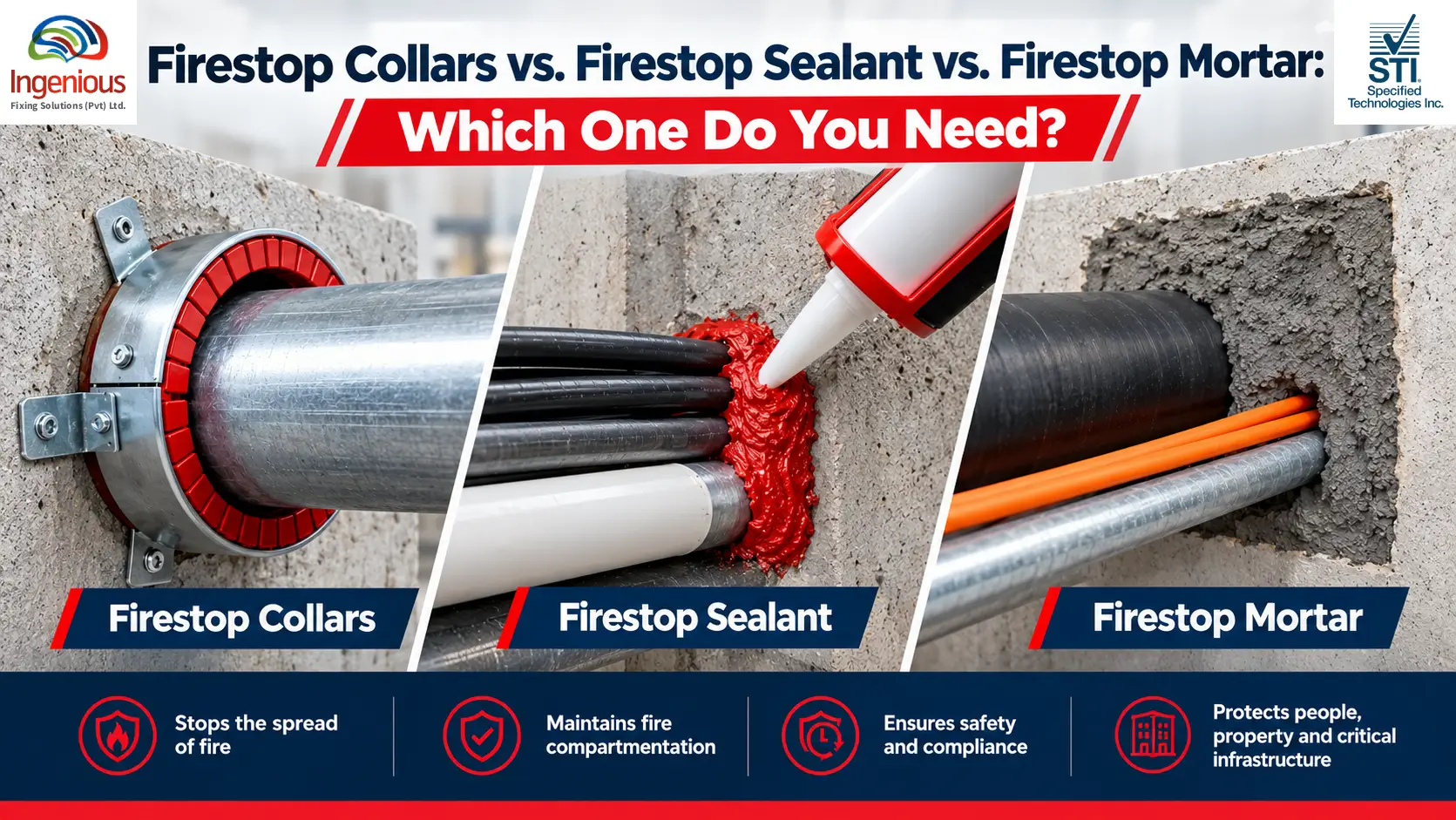
To seal these gaps, engineers use three main passive firestopping products: firestop collars, firestop sealants, and firestop mortars.
At Ingenious Fixing Solutions, we partner directly with Specified Technologies Inc. (STI)—the global leader in passive fire protection systems to supply UL-listed STI SpecSeal® firestopping products across Pakistan.
Choosing the right STI firestop product can be confusing. Do you need a solid firestop collar? Should you apply a flexible firestop sealant? Or is a heavy-duty firestop mortar the best fit?
This guide breaks down each product in simple, everyday language. We will explore how they work, where to use them, and how to select the exact STI firestop system for your project.
What Is Passive Fire Protection and Why Is Firestopping Essential?
Active fire protection includes fire sprinklers, smoke detectors, and fire alarms. These tools work to detect or extinguish a fire after it starts.
Passive fire protection works quietly in the background. It does not need electricity or water. Instead, it relies on fire-rated walls, floors, and certified firestop materials to contain fires where they originate.
When contractors run MEP (Mechanical, Electrical, and Plumbing) services through walls and floor slabs, they disrupt the continuous fire rating of those structures.
A proper firestop restoration system fills the open space around these utility penetrations. It restores the original fire rating of the wall or floor assembly—usually from 1 to 4 hours.
If you use the wrong product, the seal can fail under extreme thermal stress. Smoke and flames will quickly breach the barrier. That is why choosing the correct product type matters.
Product #1: Firestop Collars
What Is a Firestop Collar?
A firestop collar is a prefabricated metal ring lined with a high-expansion intumescent material. The outer shell is usually made of heavy-gauge galvanized steel or stainless steel. Inside the shell sits a thick strip of specialized intumescent compound.
When exposed to high temperatures—typically around 350°F (177°C)—the internal material reacts chemically. It expands up to 30 or 40 times its original volume.
How Does a Firestop Collar Work?
Firestop collars are designed specifically for combustible penetrations, such as plastic pipes.
When a structural fire breaks out, plastic pipes (like PVC, CPVC, ABS, or PP) soften, melt, and burn away quickly. This leaves a wide, open hole through the concrete slab or drywall.
The intumescent material inside the STI firestop collar detects the rising heat. It expands inward with tremendous pressure. As it expands, it crushes the melting plastic pipe and completely seals the opening. This solid, insulating char blocks fire, heat, and toxic smoke from passing through to the next room or floor.
Best Applications for Firestop Collars
- Plastic Plumbing Pipes: Drain, waste, and vent (DWV) piping made of PVC, CPVC, ABS, or Polypropylene.
- Large Diameter Plastic Piping: Heavy-duty plastic pipes up to 10 or 12 inches in diameter.
- Solid Floor Slabs & Concrete Walls: Perfect for surface-mounting directly onto the underside of concrete floor slabs or onto wall faces.
STI SpecSeal® Firestop Collar Solutions
STI manufactures some of the most reliable collars in the passive fire safety industry:
- STI SpecSeal® LCC Firestop Collars: Factory-made, low-profile collars designed for quick installation around plastic pipes in both wall and floor penetrations.
- STI SpecSeal® Firestop Wrap Strips: Flexible, roll-form intumescent strips (like the SpecSeal® BLU or RED series) that can be wrapped around pipes and secured with restraining collars for custom pipe sizes.
Product #2: Firestop Sealant (Caulk)
What Is a Firestop Sealant?
Firestop sealant often called firestop caulk, is a flexible sealant formulated to withstand high temperatures and direct flame. Unlike standard commercial silicone or painter’s caulk, certified firestop sealants undergo rigorous testing under ASTM E814 (UL 1479) standards.
They come in convenient dispensing tubes, foil sausages, and bulk pails. You apply them using a standard caulking gun or bulk dispensing pump.
How Does a Firestop Sealant Work?
Firestop sealants fill the small annular space between a utility penetrant and the surrounding wall or floor edge. They offer exceptional adhesion to concrete, masonry, drywall, steel, and copper.
There are two primary types of STI SpecSeal® firestop sealants:
- Intumescent Sealants: These water-based acrylic sealants expand when exposed to heat. They are ideal for non-combustible pipes, small plastic conduits, and cable bundles. As heat rises, the sealant expands slightly to fill minor gaps caused by burning cable jackets or pipe insulation.
- Silicone Sealants: These non-expanding, elastomeric sealants remain highly flexible. They provide superior resistance to moisture, water washdown, and structural movement. They are ideal for expansion joints, outdoor openings, and places with frequent pipe movement.
Best Applications for Firestop Sealants
- Metal Pipe Penetrations: Copper pipes, steel conduits, cast-iron pipes, and stainless steel lines.
- Electrical & Telecom Cables: Single cables, bundled network cables, and cable trays passing through drywall or concrete partitions.
- Linear Construction Joints: Top-of-wall joints, perimeter curtain wall gaps, and expansion joints where building movement occurs.
- Small Annular Gaps: Tight openings where mechanical collars or heavy mortars cannot fit easily.
STI SpecSeal® Firestop Sealant Solutions
As discussed in our deep dive into SpecSeal® Firestop Sealants, STI offers industry-leading sealant formulations:
- STI SpecSeal® SSS Intumescent Firestop Sealant: The ultimate general-purpose acrylic firestop caulk for everyday cable, conduit, and metal pipe penetrations.
- STI SpecSeal® LCI Intumescent Sealant: A versatile, economic latex sealant designed for high performance in standard construction assemblies.
- STI SpecSeal® SIL300 Silicone Firestop Sealant: A 100% silicone sealant built for applications needing water resistance, environmental durability, and high movement capability.
Product #3: Firestop Mortar
What Is Firestop Mortar?
Firestop mortar is a lightweight, rapid-setting, cement-based powder. You mix it with water on the job site and pour or trowel it into large structural openings.
Unlike standard masonry cement, firestop mortar is non-shrinking, thermally insulating, and engineered specifically for fire containment.
How Does a Firestop Mortar Work?
When mixed and cured, firestop mortar forms a solid, rigid, heat-resistant barrier across large openings in floors and walls. It fills the entire void around complex combinations of pipes, ducts, and cable trays.
Firestop mortar does not expand significantly when heated. Instead, it relies on high density, non-combustible mineral content, and thermal insulation to block heat transfer and structural burnout.
Best Applications for Firestop Mortar
- Large Structural Floor Voids: Large openings in concrete floor slabs where multiple utilities pass through together.
- Multi-Service Penetrations (Mixed Openings): Single large cutouts containing a mix of cable trays, steel pipes, copper lines, and HVAC ductwork.
- High-Foot-Traffic Areas: Floor openings that need structural load-bearing strength so technicians can safely walk near or over them during routine maintenance.
STI SpecSeal® Firestop Mortar Solutions
- STI SpecSeal® SSM Firestop Mortar: A polypropylene fiber-reinforced mortar that cures quickly, will not shrink, and bonds tightly to concrete substrates, steel frames, and cable tray assemblies.
Direct Comparison: Collars vs. Sealants vs. Mortar
To help you choose the right product quickly, here is a breakdown of how firestop collars, sealants, and mortars compare side-by-side:
| Feature / Property | Firestop Collars | Firestop Sealants | Firestop Mortar |
| Primary Material | Metal shell with intumescent liner | Intumescent acrylic or silicone compound | Fiber-reinforced cementitious powder |
| Primary Target Penetrant | Combustible plastic pipes (PVC, CPVC, ABS) | Non-combustible pipes, cables, small gaps | Large floor voids, mixed MEP services |
| Opening Size | Fits specific pipe diameters (1.5″ to 12″) | Small to medium annular gaps (up to 2″-3″) | Large openings and multi-service voids |
| Expansion Capability | High expansion (up to 30x–40x) | Moderate expansion (or non-expanding) | Non-expanding / Insulating barrier |
| Structural Load Capacity | None (pipe-mounted) | Flexible (non-load bearing) | High load-bearing capacity when cured |
| Installation Method | Mechanical anchors / screws to wall or floor | Caulking gun, foil sausage gun, or trowel | Mix with water, pour, or trowel into place |
| Movement Tolerance | Rigid fit around pipe | High (especially silicone variants) | Rigid / Solid structural fit |
How to Choose: A Step-by-Step Decision Guide
Selecting the right firestop system involves checking a few key project parameters. Follow these simple steps when reviewing your MEP floor plans:
Step 1: Identify the Penetrant Material (Combustible vs. Non-Combustible)
- If your pipe is plastic (PVC, CPVC, ABS, PP): You must use a product with high-expansion intumescent capability, such as an STI SpecSeal® Firestop Collar or STI Firestop Wrap Strip. Standard sealants will not expand fast enough or generate enough force to crush a melting plastic pipe.
- If your penetrant is metal (Steel, Copper, Cast Iron): Metal pipes do not melt in standard fires. Your main goal is sealing the space around the pipe to stop smoke and flame passage. An STI SpecSeal® Intumescent or Silicone Sealant is ideal here.
Step 2: Measure the Size of the Opening
- Small Annular Gaps (Under 2 Inches): Use an STI Firestop Sealant. It easily fills small gaps around conduits, single pipes, or small cable bundles.
- Medium Round Openings for Individual Plastic Pipes: Use an STI Factory-Made Firestop Collar.
- Large Structural Openings / Floor Cutouts: If you have a large hole in a concrete slab with multiple pipes, cable trays, and ducts, use STI SpecSeal® SSM Firestop Mortar. Mortar fills large spaces efficiently without slumping or sagging.
Step 3: Assess Environmental and Building Conditions
- High Moisture / Outdoor Areas: Choose an elastomeric silicone firestop sealant like SpecSeal® SIL300. Water-based acrylic sealants can wash away if exposed to standing water before curing completely.
- Building Movement & Expansion Joints: Select a flexible silicone firestop sealant that tolerates vibration and movement without cracking.
- Floor Weight-Bearing Requirements: Use SpecSeal® SSM Firestop Mortar when floor openings need to support light foot traffic during future building maintenance.
Common Firestopping Mistakes to Avoid on Site
Even high-quality products like STI SpecSeal® can fail if installed incorrectly. Here are five common site errors and how to avoid them:
1. Using Standard Expanding Foam or Commercial Caulk
Regular yellow polyurethane foam and standard painter’s caulk are highly flammable. In a fire, they melt and fuel the flames. Always check for a genuine UL-classified testing mark on your firestop packaging.
2. Using Firestop Caulk on Large Plastic Pipes Without a Collar
Applying standard firestop caulk around a 4-inch PVC pipe is a major safety hazard. When the plastic pipe melts away, a thin layer of caulk cannot close the large opening. Always use a factory-tested STI Firestop Collar or heavy-duty Wrap Strip on plastic piping.
3. Mixing Product Brands Within the Same Penetration System
Firestop systems are tested and certified as complete assemblies. Combining Brand A sealant with Brand B backing material invalidates the UL system certification. Always stick to a single, complete system—such as an all-STI SpecSeal® installation—to maintain full code compliance.
4. Forgetting Backing Materials
Many UL-classified firestop sealant designs require mineral wool backing installed inside the wall cavity before applying the sealant. Skipping the mineral wool reduces the system’s fire rating significantly.
5. Over-Filling or Under-Filling Annular Spaces
Applying too little sealant leaves weak spots that smoke can penetrate. Applying too much wastes material and money. Always follow the exact depth and width specs listed in your STI UL system drawing.
Complete Your Fire Protection Strategy with INEP Group
At Ingenious Fixing Solutions, we provide complete, engineered support systems for modern construction projects across Pakistan.
Beyond our lineup of STI passive firestop solutions, we supply fully integrated MEP support infrastructure to keep your building safe, structured, and compliant:
- Sikla Modular Frame & Pipe Support Systems: High-strength modular framing and heavy-duty pipe clamps engineered for industrial and commercial MEP installations.
- MKT Precision Anchoring Systems: ETA-approved chemical anchors and mechanical wedge anchors designed for reliable structural fixings in cracked and non-cracked concrete.
- nVent CADDY Seismic Bracing: Specialized seismic bracing systems engineered to safeguard critical HVAC, electrical, and fire protection piping during earthquakes.
From initial design submittals to on-site testing, our engineering team works closely with consultants, MEP contractors, and project managers to deliver certified safety solutions.
Summary Checklist: Which Firestop Product Do You Need?
- Need to seal a melting plastic pipe (PVC, CPVC, ABS)? Choose an STI SpecSeal® Firestop Collar or Wrap Strip.
- Need to seal a metal pipe, electrical cable, or narrow wall gap? Choose an STI SpecSeal® Intumescent or Silicone Sealant.
- Need to fill a large floor opening with multiple cable trays and pipes? Choose STI SpecSeal® SSM Firestop Mortar.
Need Expert Guidance on STI Firestop Systems for Your Project?
Choosing the right firestop system in Pakistan requires matching field conditions with tested UL system details. The technical team at Ingenious is here to review your project drawings, recommend certified STI SpecSeal® firestop submittals, and supply genuine products directly to your site.
Contact your nearest office today:
- Islamabad Office: +92 51-2806301-2
- Karachi Office: +92 21-34548345-48
- Lahore Office: +92 322-9922884
- Email Us: info@inepgroup.com
- Visit Us Online: inepgroup.com