A warehouse looks simple from the outside. It is a big box with a roof, a floor and a few loading doors. But inside, a lot of things are hanging, bolted and held up by small parts. Racking, pipes, cable trays, ducts, sprinkler lines and lights all depend on them.
Pakistan’s warehouse sector is growing. Online shopping, cold storage, manufacturing and retail all need more space. More stock means heavier loads. That puts more pressure on the fixings behind every shelf and every pipe.
This guide explains the main fixing and support solutions for warehouses in Pakistan. It uses plain words. It covers floor anchors, overhead supports, fire protection and earthquake bracing. You will also find a simple checklist and answers to common questions.
Why Warehouse Fixings Matter More Than You Think
A fixing is small. Its job is not. If one fails, the damage can be big.
Picture a tall pallet rack full of stock. One loose anchor can let the rack lean. A leaning rack can fall. It can hurt people and ruin goods worth millions of rupees. Then work stops while you clean up.
Warehouses also face some special problems:
- Heavy loads. Racks, mezzanines and machines put steady weight on the concrete.
- Vibration. Forklifts, conveyors and dock doors shake the building all day.
- Long runs. Pipes and cable trays travel a long way. They need support at the right spots.
- Climate. Karachi’s coastal air is salty and humid. Punjab gets very hot. Both speed up rust.
- Earthquakes. Parts of Pakistan, especially in the north, are earthquake-prone. Overhead services must not swing or drop.
- Fire risk. Stored goods can burn. Fire and smoke must not spread through walls and floors.
Good fixings handle all of this. Cheap, untested ones often do not.
1. Floor Anchors for Racking, Machines and Conveyors
Let’s start at the ground. Most warehouse racking is bolted to the concrete floor. So are conveyors, dock equipment, machine bases and safety barriers. The anchor you pick decides how well they stay put.
There are two main types: mechanical and chemical.
Mechanical anchors
A mechanical anchor expands inside a drilled hole. It grips the concrete by friction. It can take load as soon as you tighten it. There is no waiting time.
MKT mechanical anchors cover most warehouse jobs. Here are the ones worth knowing:
- Bolt anchor BZ Plus has a long thread. That makes it a good match for thicker base plates on racking and steel columns.
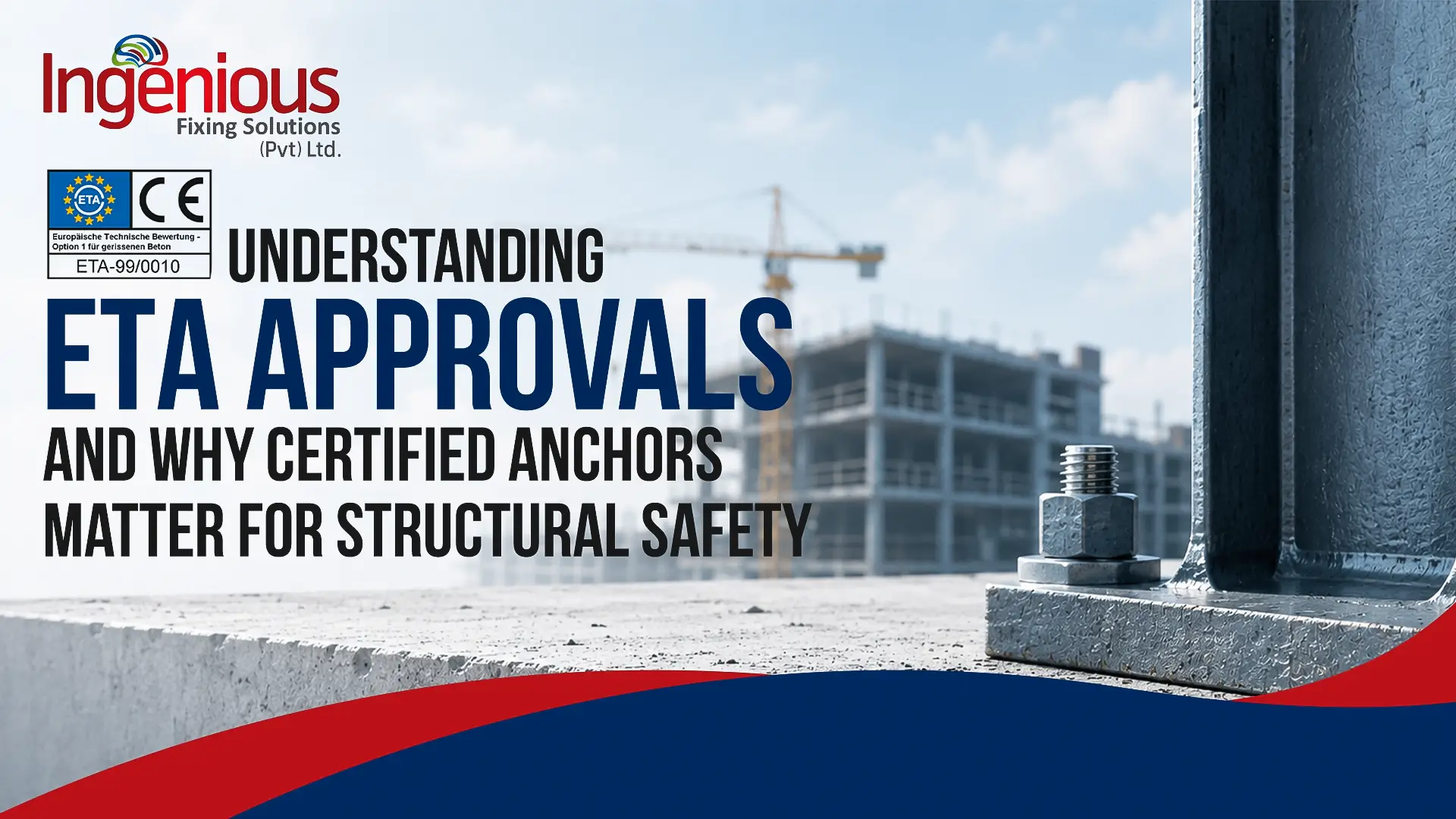
- Bolt anchor BZ3 comes with a European Technical Assessment (ETA). That means its performance is backed by independent testing.
- Bolt anchor B also has a long thread, which gives you room to fit different plate thicknesses.
- Heavy-duty anchor SZ suits heavy machinery and steel frames that carry big loads.
- Drop-in anchor E / ES sits in the hole before the bolt goes in. It is handy when you need to hang threaded rods from a slab above.
Chemical anchors
A chemical anchor works like glue. You drill a hole and fill it with resin. Then you push in a threaded rod. The resin hardens and bonds the rod to the concrete.
The big plus is that this method does not push the concrete outward. So you can fix closer to slab edges. You can also place anchors closer together. That helps when floor space is tight.
MKT offers several resin options for warehouses:
- Injection System VMU Plus is an all-round resin for cracked and uncracked concrete.
- Injection System VME Plus is another option for cracked and uncracked concrete.
- Injection System VM-EA is a versatile epoxy acrylate system.
- MKT anchor rods, screen sleeves and tie rods complete the system.
One warning about resin. The hole must be clean. Dust left inside weakens the bond. Always brush and blow out the hole before you inject. Also remember that curing takes time. In the heat of Sindh and Punjab it is faster. In cold weather it is slower.
Not sure which type to pick? Read our guide on chemical anchors vs mechanical anchors. Here is the short version:
- Need to load the fixing right away, in good concrete? Choose mechanical.
- Fixing near an edge, with tight spacing, or in older concrete? Choose chemical.
2. Overhead Supports for Pipes, Ducts and Cable Trays
Now look up. A warehouse ceiling is busy. Water pipes, air ducts, cable trays and lights all share the same space. Each one needs a safe way to hang.
The smart way is a modular system. You build supports from standard parts. You do not need welding. You can change the layout later if your needs change.
Sikla modular support systems
Sikla modular fixing and support systems are a strong fit for warehouses. The parts click together like a kit. That saves time on site. Here are some useful pieces:
- Cantilever Bracket AK 41 is made for single-arm wall mounting. It works well along warehouse walls.
- Beam Clamp TCS 1 is a heavy-duty connector. You can use it to hang pipes, ducts and equipment from steel beams. Many warehouses use steel frames, so this one is very handy.
- Blockset PBS 46 and Block PBH 46 let you attach pipe clamps and other parts quickly.
- Beam Section TP F100 is a galvanised box section. Use it to build steel frames and simple supports.
- Slide Set GS 2G is made for mounting mechanical equipment.
Want to know why installers like these parts? Read why Sikla pipe clamps are preferred in modern MEP projects.
nVent CADDY hangers
nVent CADDY is built around speed. Its products are known for tool-free, push-to-install designs. In a big warehouse, that adds up to real time saved. Look at these ideas:
- ROD LOCK gives you push-to-install threaded rod attachment.
- SPEED LINK is a wire rope hanging system. It is easy to adjust.
- J-hooks keep data and low-voltage cables neat and off the floor.
- The Universal Structural Bracket gives you a code-compliant way to attach supports to the building structure.
For a deeper look at HVAC and ventilation, see our HVAC support systems guide.
3. Support for Sprinkler and Fire Lines
Every large warehouse needs fire protection. Sprinkler pipes run across the ceiling. When they fill with water, they get heavy. If a support gives way, the whole system can fail when you need it most.
That is why fire lines need proper clamps. The Pipe Loop RSL N is designed for pipelines in fixed fire extinguishing systems. It is a good example of a part made for one job and made to do it well.
A few tips for fire lines:
- Use supports made for fire systems. Do not improvise.
- Fix them to solid base material with tested anchors.
- Space the supports as your design or consultant says.
4. Seismic Bracing: Keeping Overhead Services Steady
When the ground shakes, pipes and ducts swing. Swinging parts can snap their hangers and fall on people and stock. Seismic bracing stops that. It holds services steady from side to side.
The Universal Sway Brace from nVent CADDY is one option for this job. It protects non-structural parts such as pipes, ducts and electrical lines. You can read more in our article on nVent CADDY seismic bracing solutions.
Bracing is only as good as the anchor behind it. So choose anchors that are approved for seismic use where your project needs it. MKT publishes this information in its approvals. Our guide on ETA approved anchors explains how to check.
5. Firestopping: Closing the Gaps Where Fire Can Spread
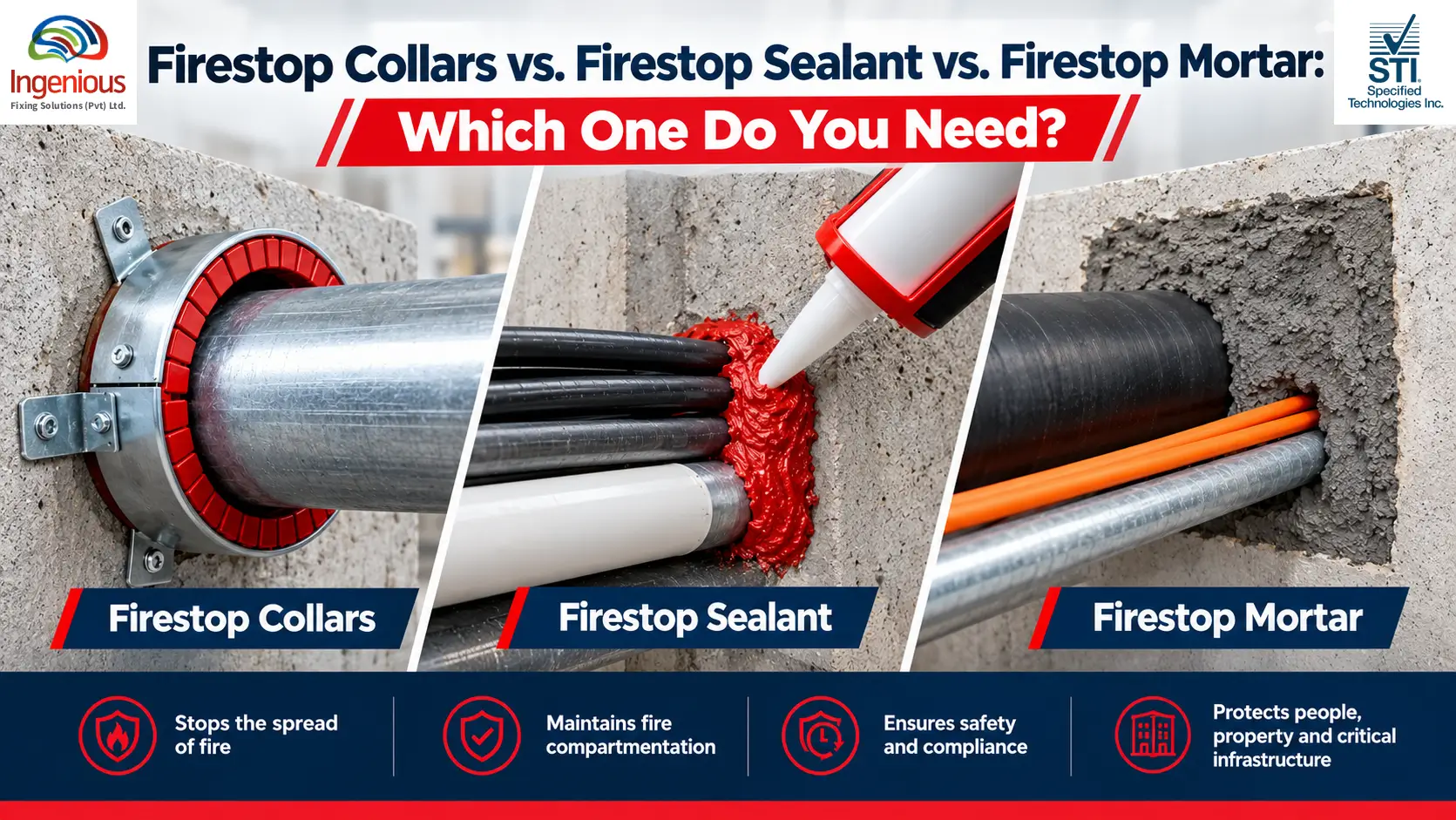
Many warehouses use fire walls to split storage into zones. That is a smart safety step. But every pipe or cable that passes through a wall makes a gap. A gap can let flames and smoke through.
Firestopping closes those gaps. Specified Technologies Inc. (STI) makes a range of SpecSeal products for this:
- SpecSeal LCC Intumescent Firestop Collars fit around pipes that pass through walls and floors.
- SpecSeal SSS Intumescent Firestop Sealant is a water-based sealant for sealing openings.
- SpecSeal LCI Intumescent Sealant is another water-based intumescent option.
- SpecSeal SSM Firestop Mortar is a lightweight mortar for larger openings.
- SpecSeal AS200 Elastomeric Spray is a latex-based firestop coating.
- SpecSeal Smoke ‘N’ Sound Acoustical Sealant helps seal against smoke and noise.
A tip for site teams: plan firestopping early. It is much easier to seal a gap when you are still installing the pipes.
6. Beating Rust in Pakistan’s Climate
Rust is a slow enemy. It eats a fixing from the surface inward. A part that looks fine can lose strength over time.
In Karachi, salty humid air speeds this up. In hot, dry cities like Lahore, heat and dust cause their own trouble. Cold stores add moisture on top. So pick your finish with care.
- Choose galvanised or stainless parts for damp or coastal sites.
- Check the finish on every part, including nuts, washers and rods.
- Avoid mixing metals that can react with each other.
Sikla parts are offered with finishes such as hot-dip galvanising. That gives long-term protection in tough places.
7. A Simple Checklist Before You Buy
Use this list when you plan a warehouse fit-out:
- Know your loads. How heavy are the racks, pipes and equipment? Include moving loads from forklifts.
- Check the concrete. Is it new or old? Is it cracked? Is it thick enough?
- Choose the right anchor type. Pick mechanical or chemical based on spacing and edge distance.
- Ask for approvals. Look for ETA papers or other test reports. Keep them for your records.
- Plan for movement. Think about vibration, heat and earthquakes.
- Choose a matching finish. Match the coating to your climate.
- Plan fire safety early. Include firestop details from the start.
- Get technical advice. A short talk before you order can save a lot of trouble later.
8. Common Mistakes to Avoid
Most fixing problems come from a few simple errors:
- Using untested anchors. Local fixes may look strong. But without data, you are guessing.
- Skipping hole cleaning. Dust in a drilled hole weakens both mechanical and chemical anchors.
- Ignoring edge distance. Anchors too close to an edge can crack the concrete.
- Using the wrong anchor for cracked concrete. Check that the anchor is approved for the base material.
- Over-tightening or under-tightening. Follow the torque guidance for each anchor.
- Mixing random parts. Parts from one system are made to work together. Stick with one system.
- Forgetting paperwork. Rejected submittals cost time. Approvals help avoid that.
9. Why a Local Partner Makes a Difference
Good products are one half of the answer. Good advice is the other half.
Ingenious Fixing Solutions supplies Sikla, MKT, STI and nVent CADDY across Pakistan. It has offices in Islamabad, Karachi and Lahore. Its team supports projects in several ways:
- Help with choosing the right anchor size, depth and spacing
- On-site pull-out testing to check how well anchors hold in your concrete
- Hands-on training for installation crews
- Support with approval documents
The team has also supported large projects. You can see one example in the Emaar Park Edge Tower A case study. You can browse every product in the Product catalog.
For more on industrial projects, read our guide to heavy-duty fixing solutions for industrial facilities in Pakistan.
Frequently Asked Questions
What anchors are best for warehouse racking in Pakistan?
Most racking is fixed with mechanical anchors, such as wedge-type bolt anchors. The right choice depends on the rack load, the floor thickness and the base plate. Check the anchor’s approval and ask for advice if you are unsure.
When should I use chemical anchors in a warehouse?
Use them near slab edges, where anchors must sit close together, or when the concrete is older. They are also used for rebar connections. Remember that they need time to cure before they carry load.
Do warehouse fixings need seismic approval?
If your site is in an earthquake-prone area, yes, it is wise. Overhead pipes, ducts and cable trays should be braced. The anchors behind the braces should also be approved for seismic use where your design requires it.
Why is firestopping important in a warehouse?
Warehouses hold a lot of burnable stock. Fire walls slow the spread of flames. But gaps around pipes and cables can undo that work. Firestop products seal those gaps and keep the wall doing its job.
Can modular support systems replace welded steel supports?
In many cases, yes. Modular systems like Sikla are made from reusable parts. They install faster, need no welding and are easy to change later. Your engineer should confirm the design for your loads.
Final Thoughts
A safe warehouse starts with the small parts you cannot see from the loading bay. The right anchors keep racks and machines steady. The right supports keep pipes, ducts and cables in place. Seismic braces and firestop products add protection when things go wrong.
Take your time with these choices. Ask for approvals. Match the product to the job and to the climate. And talk to people who know the products well.
Planning a new warehouse or upgrading an old one? Contact the team at Ingenious Fixing Solutions for product advice and project support in Karachi, Lahore, Islamabad and across Pakistan.